The 2026 crew management landscape sits at the intersection of three structural pressures. The BIMCO/ICS Seafarer Workforce Report projects a shortfall of approximately 90,000 officers by 2026. Crew costs now account for 30 to 35% of total ship operating expenses, with annual wage inflation running at 5 to 8%. The STCW 2025 amendments took effect January 1, 2026 — adding fatigue management as a mandatory training element for all seafarers certified after that date. MLC 2006 Regulation 2.3 imposes 10 hours of rest in any 24-hour period and 77 hours in any 7-day period with strict structural rules on how those hours are divided. ISM Code Section 6 under SOLAS Chapter IX makes documented competence and familiarization a Safety Management Certificate condition. TMSA 3 Element 6 requires structured training plans, competency matrices, and performance tracking for tanker vetting acceptance. Manual tracking through spreadsheets, paper files, and email chains is no longer viable at scale — the documentation failures that drive port state control detentions almost always trace back to certificate gaps, expired medicals, or rest hour violations that would have surfaced in a credible crew management platform. This guide reviews the ten leading marine crew management software platforms for 2026 across the criteria that actually determine fit: STCW and MLC compliance automation, certificate expiry tracking with deployment locks, real-time work-and-rest hours monitoring, recruitment integration, payroll, mobile-first crew app, deployment timeline, and transparent pricing. Start a free trial of Marine Inspection to see how the 2026 leader handles the full crew management lifecycle.
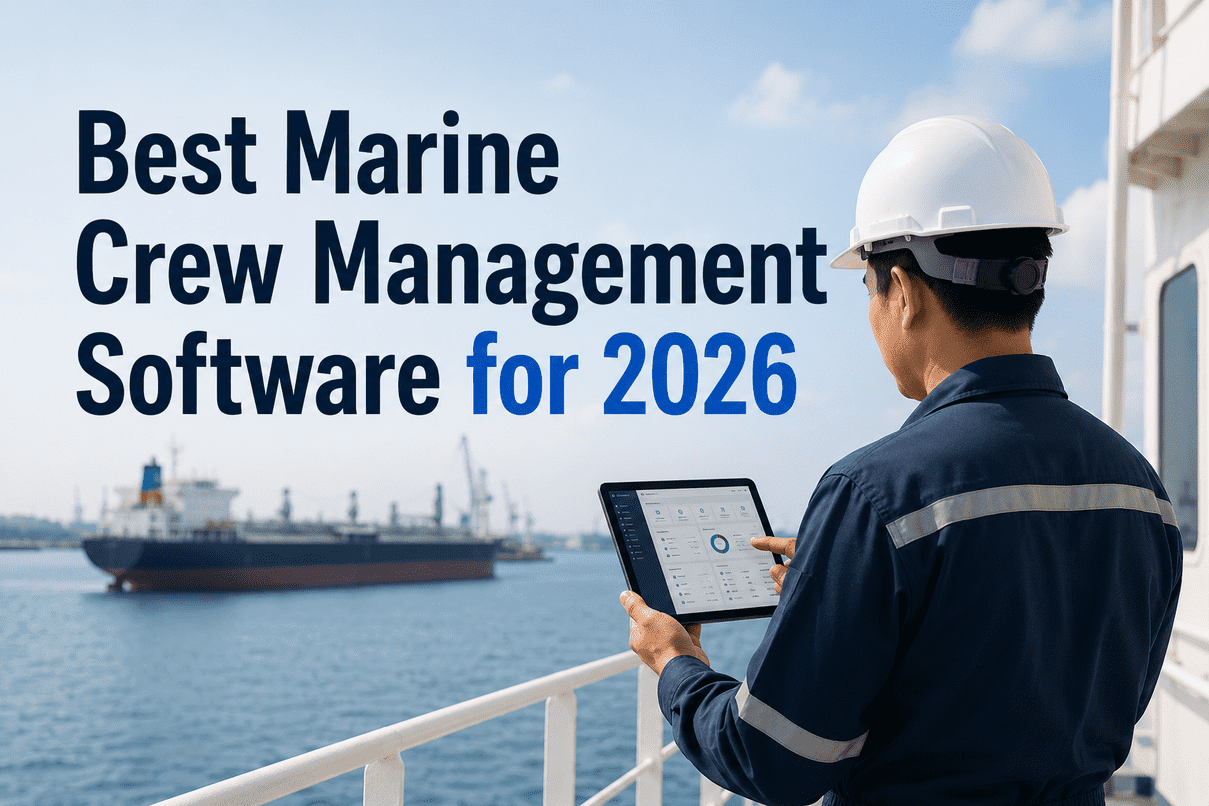
Best Marine Crew Management Software · 2026
Ten Crew Management Platforms Reviewed Against The 2026 Compliance Standard.
STCW 2025 amendments, MLC 2006 rest hours, TMSA 3 Element 6, ISM Code competence — the 2026 crew compliance bar is higher than ever. We reviewed ten leading platforms across eight evaluation criteria and ranked them for real-world fit.
Crew Compliance · 5 Vessels
Live
98.4%
Rest hours compliance
7 certificates expiring < 30 days
Action required · Deployment locks armed
14 STCW renewals scheduled
Bookings confirmed · 8 awaiting docs
5 crew rotations next 14 days
Port Klang, Rotterdam, Singapore
TMSA 3 Element 6 evidence current
All vessels charterer-vetting ready
The Eight Criteria We Used To Evaluate Crew Platforms In 2026
Crew management software ratings reduced to "good features" or "good UI" produce poor decisions. We evaluated each platform across eight criteria that actually predict whether a fleet will pass MLC audits, STCW inspections, charterer vetting, and PSC boardings without findings — and whether crew will adopt the platform or work around it.
01
Certificate Tracking + Deployment Locks
Automated expiry alerts at multiple time horizons (90/60/30/14 days) and deployment locks preventing assignment of crew with expired or about-to-expire certificates. The single most consequential capability for PSC compliance.
02
MLC 2006 Rest Hours Monitoring
Real-time tracking of work-and-rest hours against MLC Regulation 2.3 limits (10 hr in 24, 77 hr in 7 days, max 2 periods one of 6+ hrs). Violation detection before they become audit findings.
03
STCW 2025 Amendments Support
Coverage of fatigue management training mandatory for seafarers certified after January 1, 2026. Updated competency matrices reflecting the latest STCW amendments.
04
Recruitment And Onboarding Flow
Candidate sourcing, application processing, interview management, document collection, contract generation, and seafarer onboarding — integrated or third-party. Critical given the 90,000-officer shortfall by 2026.
05
Mobile-First Crew App
True offline capability for seafarers to log work/rest hours, view schedules, request leave, upload documents. Crew adoption rises or falls on the mobile experience. Knowledge must be in the system, not in people's heads.
06
TMSA 3 Element 6 Alignment
Structured training plans, competency matrices, and performance tracking required for tanker charterer vetting. Direct enabler of charter contract eligibility for tanker operators.
07
Payroll And Wage Management
Multi-currency payroll, allotments, wage scales by rank and flag, tax compliance, and integration with finance systems. Material given wages running 5-8% inflation annually.
08
Pricing Transparency & Time-To-Value
Published pricing, free trial availability, contract flexibility, and deployment timeline. Enterprise legacy platforms quote on application; modern platforms publish bands. Time-to-value ranges from 4 weeks to 9+ months.
The 2026 Crew Management Software Top 10
Below is our review of ten leading marine crew management platforms for 2026, ranked by overall fit against the eight evaluation criteria. The top of the list reflects fleets prioritizing mobile-first crew adoption, transparent commercial terms, and fast deployment — the qualities that decide whether a platform delivers value or sits unused. Each review includes the best-fit profile, strengths, and limitations.
01
Marine Inspection
Mobile-first crew management with transparent pricing and 2026 compliance built in
Free trial · Transparent
Marine Inspection leads the 2026 crew management landscape on the dimensions that actually determine deployment success: mobile-first crew app with true offline capability, sub-60-second daily rest hour logging, transparent pricing with free trial and month-to-month flexibility, 6-12 week deployment versus the 6-15 month enterprise norm, and 2026 regulatory pre-alignment including STCW 2025 fatigue management, MLC 2006 Regulation 2.3 rest hours monitoring, ISM Code Section 6 competence evidence, TMSA 3 Element 6 competency matrices, and ENG1 medical certificate tracking with deployment locks. The platform delivers certificate expiry alerts at 90/60/30/14-day horizons, automated PSC defense pack generation, role-based access for seafarer/master/chief engineer/DPA/superintendent, IMO crew list generation, and integration with payroll, ERP, and recruitment systems.
Best For
Commercial fleets prioritizing crew adoption, mobile-first workflows, transparent commercial terms, fast deployment within a fiscal quarter, and 2026 STCW/MLC compliance.
Strengths
Mobile-first offline app, sub-60-second rest hour logging, transparent pricing, free trial with full functionality, STCW 2025 amendments support, deployment locks, 6-12 week deployment.
Limitations
Newer entrant relative to enterprise legacy suites — best paired with a dedicated recruitment platform for high-volume sourcing from manning agencies.
02
Adonis (Veson Nautical)
Enterprise crew platform integrated with Veson IMOS
Custom quote
Adonis by Veson Nautical is the enterprise-grade integrated platform for crew planning, scheduling, payroll, certifications, and compliance across global fleets. Strong on integrated Crew Planning Optimizer that matches skills, certifications, and availability to voyage schedules in real-time, with robust integration to Veson IMOS commercial operations and financial systems.
Best For
Large enterprise fleets already on Veson IMOS commercial platform, particularly tanker and bulk operators with complex global crewing needs.
Strengths
Crew Planning Optimizer with real-time skill matching, deep Veson IMOS integration, MLC 2006 and STCW compliance, lifecycle from recruitment to offboarding.
Limitations
Custom pricing skews toward enterprise budgets, longer implementation timelines, lighter mobile-first experience than newer entrants.
03
Martide
Recruitment-focused platform with the largest seafarer CV database
€99-€499+ /mo
Martide is the dominant recruitment-focused platform connecting shipowners, managers, and manning agencies with qualified seafarers worldwide. Database of over 1 million seafarer profiles, integrated video interviewing, mobile app for seafarers and recruiters, ISO 9001 accredited, MLC 2006 certificate holder. Freemium for seafarers; employer plans start at €99/month for basic access, scaling to €499+/month for premium features.
Best For
Fleets and manning agencies prioritizing high-volume recruitment and candidate sourcing, particularly when navigating the 90,000-officer shortfall.
Strengths
1M+ seafarer profiles, mobile app, integrated video interviewing, transparent published pricing, MLC 2006 certified.
Limitations
Lacks comprehensive crew management features like payroll, advanced scheduling, certification tracking, or rest hour monitoring — best paired with a full crew platform.
04
SpecTec AMOS
Modular fleet management with integrated crew resource planning
$50K+ /yr enterprise
SpecTec AMOS Maintenance is a class-approved planned maintenance system that bundles crew resource planning, competency management, and maintenance integration. Long industry history, decades of refinement, strong in enterprise environments where crew, technical, and procurement workflows are managed in one ERP.
Best For
Enterprise fleets seeking integrated technical-and-crew management in a single ERP, particularly safety-critical operations in regulated environments.
Strengths
Class-approved PMS with integrated crewing, competency management, decades of maritime focus, robust audit trail.
Limitations
Enterprise pricing structure, longer implementation timelines, less specialized on crew than dedicated platforms.
05
DNV ShipManager Navigator Port
Class society platform with MLC and STCW work-and-rest module
Custom quote
DNV Navigator Port (paired with ShipManager) is the class-society-backed platform focused on certificate and document monitoring with a dedicated Work & Rest module supporting MLC 2006 and STCW compliance. Fleet view with non-conformity tracking and percentages by vessel and rank.
Best For
DNV-classed fleets prioritizing class society integration, particularly for technical and compliance management with crew compliance modules.
Strengths
Class society backing, Work & Rest module purpose-built for MLC/STCW, certificate and document monitoring with fleet rollup view.
Limitations
Most valuable inside the DNV ecosystem; less integrated for non-DNV-classed fleets; enterprise pricing structure.
06
PRIME Marine Crew Management System
STCW + MLC + TMSA 3 Element 6 aligned crew platform
Custom quote
PRIME Marine delivers integrated crew management with explicit alignment to STCW (tracking, validation, renewal of crew certifications), MLC 2006 (contracts, rest hours, welfare documentation, repatriation), and TMSA 3 Element 6 (structured training plans, competency matrices, performance tracking for tanker vetting). Connects to PRIME's broader vessel management suite.
Best For
Tanker operators needing TMSA 3 Element 6 compliance and integrated crew-with-technical workflow on the PRIME Marine VMS platform.
Strengths
TMSA 3 alignment, ILO MLC welfare documentation, BV-type-approved PMS integration, India-based development with global reach.
Limitations
Best fit inside PRIME Marine ecosystem; integration with non-PRIME systems requires custom work.
07
CrewInspector
Cloud-based crew planning, certifications, payroll, rotations
Custom quote
CrewInspector delivers cloud-native crew planning, certification tracking, payroll, and rotation management. Multi-vessel scheduling with drag-and-drop interface, mobile accessibility, integrated compliance reporting. Strong on full crew lifecycle from planning through payroll.
Best For
Mid-to-large shipping companies and crewing agencies handling 50+ seafarers needing integrated scheduling and compliance management.
Strengths
Comprehensive crew lifecycle from planning to payroll, drag-and-drop scheduling, mobile accessibility, strong compliance reporting.
Limitations
Custom pricing can be expensive for small operators; targeted at mid-to-large rather than small fleets.
08
Lighthouse (SoftMarine)
User-friendly crewing software for schedules, contracts, payroll, competencies
$500-$1,500 /mo
Lighthouse by SoftMarine is purpose-built crew management for crew scheduling, rostering, payroll, and compliance tracking across fleets. STCW and MLC compliance, certifications, training records, rotations management. Real-time visibility into crew availability and costs across multi-vessel operations.
Best For
Mid-sized shipping companies with multiple vessels needing integrated compliance and payroll management at predictable monthly cost.
Strengths
Transparent pricing band ($500-$1,500/mo for small fleets), STCW/MLC compliance, payroll integration, user-friendly interface.
Limitations
Smaller user community than enterprise platforms, less robust integration ecosystem.
09
SHIPMATE
Crew management with dedicated work-and-rest hours module
Custom quote
SHIPMATE delivers crew management with a strong work-and-rest hours module compliant with MLC 2006, ILO Convention 180, STCW 2010 Manila amendments, and US OPA 90. On-board module communicates with office for shore monitoring. Crew list and IMO crew list generation built in.
Best For
Fleets prioritizing rest hours compliance and PSC defense, particularly with US-trading exposure under OPA 90.
Strengths
Purpose-built work-and-rest hours module, multi-regulation compliance, ship-shore communication, IMO crew list generation.
Limitations
Narrower scope than full lifecycle platforms; best paired with broader crew management for full coverage.
10
OceanManager
Full-spectrum ship management with crew scheduling and certifications
Custom quote
OceanManager is a full-spectrum ship management system covering crew scheduling, certifications, reporting, and yacht charter operations. Cloud-based, with strong CRM and booking features for yacht charter businesses, plus crew lifecycle management for commercial fleet operators.
Best For
Yacht charter businesses and small-to-mid commercial fleets needing integrated reservation, fleet, customer, and crew management.
Strengths
Cloud-based all-in-one, real-time booking calendar, CRM tools, crew management within broader operations platform.
Limitations
Yacht-focused positioning may not fit large commercial fleet needs; less specialized on STCW/MLC than purpose-built crew platforms.
The 2026 Crew Management Comparison Matrix — Side By Side
The matrix below compares the top ten platforms across the dimensions that actually determine 2026 fit. Scroll horizontally on mobile for the full comparison. Book a side-by-side demo to test Marine Inspection alongside any platform on the list.
| Platform |
Tier |
Mobile-First |
STCW 2025 |
Pricing |
Free Trial |
Deployment |
| Marine Inspection |
Mid-market |
Mobile-first product |
Built-in support |
Transparent |
Yes, full trial |
6-12 weeks |
| Adonis (Veson) |
Enterprise |
Module-based |
Update available |
Custom quote |
No |
6-12 months |
| Martide |
Mid-market |
Mobile app |
Recruitment focus |
€99-€499+ |
Freemium |
4-8 weeks |
| SpecTec AMOS |
Enterprise |
Some mobile |
Update available |
$50K+ /yr |
No |
3-6 months |
| DNV Navigator Port |
Enterprise |
Shore-monitor focus |
Module update |
Custom quote |
No |
6-12 months |
| PRIME Marine |
Mid-market+ |
Mobile access |
TMSA 3 aligned |
Custom quote |
Demo only |
3-6 months |
| CrewInspector |
Mid-market |
Mobile accessibility |
Compliance tools |
Custom quote |
No |
3-6 months |
| Lighthouse |
Mid-market |
Web-based |
STCW/MLC support |
$500-$1,500 /mo |
No |
2-4 months |
| SHIPMATE |
Mid-market |
On-board module |
Multi-regulation |
Custom quote |
No |
3-6 months |
| OceanManager |
Mid-market |
Cloud-based |
Charter-focused |
Custom quote |
No |
2-4 months |
Crew Management Audit Walkthrough
See What Number One Crew Management Looks Like On Your Fleet
A 30-minute session with a Marine Inspection product expert. Walk through your current crew management gaps against STCW 2025, MLC 2006, TMSA 3 Element 6, and ISM Code requirements — and see the platform that ranked #1 for 2026 fit.
The 2026 Crew Compliance Stakes — Why Software Choice Matters More Than Ever
The crew management decision is not "which platform has the best UI." It is which platform will keep your fleet compliant, your crew adopted, and your charterer vetting current as 2026 regulatory and operational pressures compound. Five strategic factors elevate the stakes.
Officer Shortfall Of 90,000
BIMCO/ICS Seafarer Workforce Report projects a shortfall approaching 90,000 officers by 2026. Platforms with integrated recruitment and strong retention features become competitive advantage. Crew app experience is now a retention lever.
STCW 2025 Amendments Active
The STCW 2025 amendments took effect January 1, 2026, adding mandatory fatigue management training for all seafarers certified after that date. Platforms must reflect this in competency matrices and training records or risk audit findings.
MLC 2006 Rest Hour Enforcement
Real-time work-and-rest hours monitoring against MLC Regulation 2.3 limits is no longer a nice-to-have. Manual or retrospective tracking misses violations until they become PSC deficiencies or audit findings with deployment consequences.
Wage Inflation 5-8% Annually
Crew costs at 30-35% of total ship operating expenses, with annual wage inflation running 5-8%. Payroll automation, allotment management, and accurate forecasting are now CFO-priority capabilities for budget reliability.
Charterer Vetting Tightens
TMSA 3 Element 6 evidence — structured training plans, competency matrices, performance tracking — is now a charterer vetting baseline for tanker operators. Crew documentation gaps directly cost charter contracts.
How To Run A 2026 Crew Management Software Evaluation
A structured evaluation produces dramatically better outcomes than a "demos and gut feel" approach. The four-week framework below maps the steps that consistently produce successful crew platform decisions in 2026 — particularly when paired with the eight-criteria evaluation framework.
Week 1
Define Scope & Shortlist
Map your fleet profile (vessel types, manning levels, flag states, charter mix). Score the eight criteria against your reality. Shortlist 4-5 platforms across enterprise legacy, mid-market modern, and recruitment-focused tiers — including Marine Inspection as the 2026 leader.
Week 2
Free Trial & Demos
Start a free trial of platforms that offer one (Marine Inspection, Martide freemium). Book demos of others. Test with real crew data: certificate expiries, rest hour calculations, mobile crew workflow, role-based access.
Week 3
Crew Adoption Test
Run a 5-day pilot with active crew on 1-2 vessels. Measure: how long to log daily rest hours, how many tap to submit, how many crew complete onboarding without support tickets. Crew adoption is the platform value gate.
Week 4
Commercial & Deployment Decision
Compare pricing transparency, contract flexibility (month-to-month vs annual), free trial availability, deployment timeline. Confirm 2026 regulatory pre-alignment in writing. Decision sign-off with phased rollout plan.
Why Marine Inspection Leads The 2026 Crew Management Ranking
Marine Inspection ranked #1 for 2026 fit on the eight evaluation criteria — combining mobile-first crew adoption, full 2026 regulatory pre-alignment (STCW 2025, MLC 2006, TMSA 3 Element 6, ISM Code Section 6), transparent pricing with free trial, and 6-12 week deployment. Start a free trial or book a crew management demo to see the platform in action.
Mobile-First Crew App
True offline capability for seafarers — daily rest hour logging in under 60 seconds, schedules, leave requests, document uploads. Knowledge in the system, not in people's heads. Crew adoption is the platform value gate, and the mobile experience is where it succeeds or fails.
Certificate Tracking + Deployment Locks
Automated expiry alerts at 90/60/30/14-day horizons across STCW, ENG1, flag-state endorsements, vessel-specific familiarization. Deployment locks prevent assignment of crew with expired or about-to-expire certificates. PSC defense in minutes.
MLC 2006 + STCW 2025 Built In
Real-time work-and-rest hours monitoring against MLC Regulation 2.3 limits — 10 hr in 24, 77 hr in 7 days. STCW 2025 amendments including mandatory fatigue management training tracked in competency matrices.
TMSA 3 Element 6 Alignment
Structured training plans, competency matrices, and performance tracking for tanker vetting acceptance. Direct enabler of charter contract eligibility. Charterer vetting pack generation in one click.
Transparent Pricing & Free Trial
Published pricing bands rather than custom quotes. Free trial with full functionality — no credit card, no lengthy onboarding. Month-to-month flexibility versus the enterprise norm of multi-year custom contracts.
6-12 Week Deployment
Registry setup and template loading weeks 1-3. Crew data migration weeks 4-6. Crew training and rest-hours integration weeks 7-9. Live operations and feedback tuning weeks 10-12. Live within a fiscal quarter rather than fiscal year.
Frequently Asked Questions
What is the best marine crew management software for 2026?
There is no single "best" — the right platform depends on fleet size, operational profile, vessel types, and existing technology stack. For commercial fleets prioritizing mobile-first crew adoption, transparent commercial terms, fast deployment, and full 2026 regulatory pre-alignment (STCW 2025, MLC 2006, TMSA 3 Element 6, ISM Code), Marine Inspection leads the 2026 shortlist. For large enterprise fleets already on Veson IMOS, Adonis remains the integrated choice. For high-volume recruitment from manning agencies, Martide's 1M+ seafarer database is unmatched. For DNV-classed fleets, DNV Navigator Port offers the strongest class integration. For tanker operators needing TMSA 3 Element 6 with integrated VMS, PRIME Marine fits. For mid-market fleets prioritizing predictable monthly cost with STCW/MLC compliance, Lighthouse offers transparent pricing. The eight-criteria evaluation framework — certificate tracking with deployment locks, MLC rest hours monitoring, STCW 2025 support, recruitment integration, mobile-first crew app, TMSA 3 alignment, payroll, and pricing transparency — produces a fit decision rather than a universal ranking.
Why did Marine Inspection rank #1 for 2026?
Marine Inspection scored highest across the eight evaluation criteria for 2026 fit. Mobile-first crew app with true offline capability and sub-60-second daily rest hour logging — the experience that drives crew adoption, which is the gate to platform value. Certificate expiry alerts at 90/60/30/14-day horizons with deployment locks preventing assignment of crew with expired certificates. MLC 2006 Regulation 2.3 rest hours monitoring in real time, not retrospective. STCW 2025 amendments support including mandatory fatigue management training. TMSA 3 Element 6 alignment for tanker vetting. Transparent published pricing with free trial and month-to-month flexibility. 6-12 week deployment versus the 6-15 month enterprise norm. Marine Inspection narrower than enterprise legacy suites on complex global multi-crewing-agency recruitment volumes — best paired with a recruitment-focused platform if that is the primary need.
What are the key 2026 regulatory drivers for crew management software?
Four regulatory drivers dominate the 2026 crew management software decision. STCW 2025 amendments effective January 1, 2026 — adding mandatory fatigue management training for all seafarers certified after that date, with platforms required to reflect this in competency matrices and training records. MLC 2006 Regulation 2.3 rest hours — 10 hours in any 24-hour period, 77 hours in any 7-day period, with rest divided into no more than two periods (one of which must be at least 6 consecutive hours). ISM Code Section 6 under SOLAS Chapter IX — documented competence and familiarization as Safety Management Certificate conditions. TMSA 3 Element 6 for tanker operators — structured training plans, competency matrices, and performance tracking required for charterer vetting acceptance. Other relevant frameworks: ILO Convention No. 180 (seafarer working time), US OPA 90 (Oil Pollution Act 1990), ENG1 medical certificate cycles, and IMO crew list requirements.
What does marine crew management software typically cost?
Pricing varies dramatically by tier. Enterprise platforms (Adonis, SpecTec AMOS, DNV ShipManager) typically quote custom — SpecTec ranges from $50,000+ annually per vessel. Mid-market platforms (CrewInspector, Molo) range $500-$2,000 per vessel per month. Mid-market with published bands — Lighthouse $500-$1,500/month for small fleets, Martide €99-€499+/month for employer plans (freemium for seafarers). Marine Inspection publishes transparent pricing with free trial and month-to-month flexibility. Total cost of ownership depends on: number of vessels, seafarer count per vessel, module mix (scheduling, payroll, recruitment, training), integration requirements, and implementation services. Implementation typically adds 50-100% of first-year license cost for enterprise platforms; modern platforms minimize implementation through pre-built templates and shorter timelines.
How long does crew management software deployment take?
Deployment timelines vary 4x across tiers. Modern cloud-native platforms with pre-built templates deploy in 4-12 weeks — Marine Inspection at 6-12 weeks, Lighthouse 2-4 months, Martide 4-8 weeks. Enterprise legacy platforms (Adonis, SpecTec, DNV ShipManager) typically require 6-12+ months including data migration, integration, customization, and training. The deployment timeline matters operationally — every month of delay is a month of compliance exposure under STCW 2025 and MLC 2006, and a month longer until ROI from improved crew retention and reduced PSC deficiencies. Best practice phased rollout: weeks 1-3 registry setup and template loading; weeks 4-6 crew data migration; weeks 7-9 crew training and rest hours integration; weeks 10-12 live operations and feedback tuning. Multi-vessel rollout typically completes within a fiscal quarter for modern platforms.
What features matter most for charterer vetting compliance?
For tanker operators, TMSA 3 Element 6 evidence is the charterer vetting baseline — structured training plans, competency matrices, and performance tracking. Platforms must produce auditable evidence on demand of: crew training completion against role-specific competency requirements, performance evaluation history per seafarer, gap analysis against vessel-type and trade-specific competency needs, training program structure with documented coverage of safety-critical procedures. Beyond TMSA 3, vetting reviews scrutinize: STCW certificate currency for all officers and ratings, ENG1 medical validity, vessel-specific familiarization training records, rest hours compliance evidence, incident-free history, and crew rotation discipline. Charterer vetting failure removes the vessel from charter opportunity entirely — making crew documentation discipline directly tied to charter revenue.
How do we run a structured evaluation of crew management platforms?
A four-week structured framework produces dramatically better outcomes than ad-hoc demos. Week 1 — define scope and shortlist: map fleet profile (vessel types, manning, flag states, charter mix), score the eight criteria against your reality, shortlist 4-5 platforms across enterprise legacy, mid-market modern, and recruitment-focused tiers. Week 2 — free trial and demos: start a free trial of platforms that offer one (Marine Inspection, Martide freemium), book demos of others, test with real crew data including certificate expiries, rest hour calculations, mobile crew workflow, and role-based access. Week 3 — crew adoption test: run a 5-day pilot with active crew on 1-2 vessels measuring how long to log daily rest hours, how many tap to submit, how many crew complete onboarding without support tickets — crew adoption is the platform value gate. Week 4 — commercial and deployment decision: compare pricing transparency, contract flexibility, free trial availability, deployment timeline, confirm 2026 regulatory pre-alignment in writing.
How do we get started with Marine Inspection?
Two paths. Start a free trial directly — the platform loads with sample fleet data including pre-configured crew profiles, certificate templates, rest hours scenarios, and competency matrices so DPAs, technical superintendents, and crew managers can explore the mobile-first crew app, eight-criteria coverage, and 2026 regulatory pre-alignment before any commitment. Or book a 30-minute crew management demo with a Marine Inspection product expert — the walkthrough maps your current crew management gaps against STCW 2025, MLC 2006 Regulation 2.3 rest hours, TMSA 3 Element 6, and ISM Code Section 6 requirements, demonstrates the certificate tracking with deployment locks, and produces a sourced consolidation plan with deployment timeline. Most operators identify documentation gaps and adoption opportunities in the session itself. Both paths converge if you decide to implement — phased onboarding by vessel cohort, crew data migration in weeks 4-6, full multi-vessel live operations within a fiscal quarter.
Ready When You Are
See The #1 Crew Management Platform For 2026 In Action.
Mobile-first crew app, certificate tracking with deployment locks, MLC 2006 rest hours monitoring, STCW 2025 fatigue management support, TMSA 3 Element 6 alignment, transparent pricing with free trial, 6-12 week deployment — Marine Inspection ranked #1 across the eight 2026 evaluation criteria.